The Neo-Aramaic dialects are vernacular varieties of the Aramaic language spoken among small communities in Syria and Iraq as well as Turkey, Iran, Lebanon, and the Assyrian diaspora (Israel, California, etc.). These dialects represent the last remnants of the Northwest Semitic branch of Semitic languages which can trace their lineage back more than 3000 years of uninterrupted continuity (cp. Modern Hebrew which is a revived language). The four major branches of Neo-Aramaic are Western Neo-Aramaic near Damascus, Central Neo-Aramaic in southeast Turkey, Northeast Neo-Aramaic in Iraq, and Neo-Mandaic in Iran. This page collects media and bibliographic resources dedicated to the Neo-Aramaic dialects.
The Dialect of Barwar
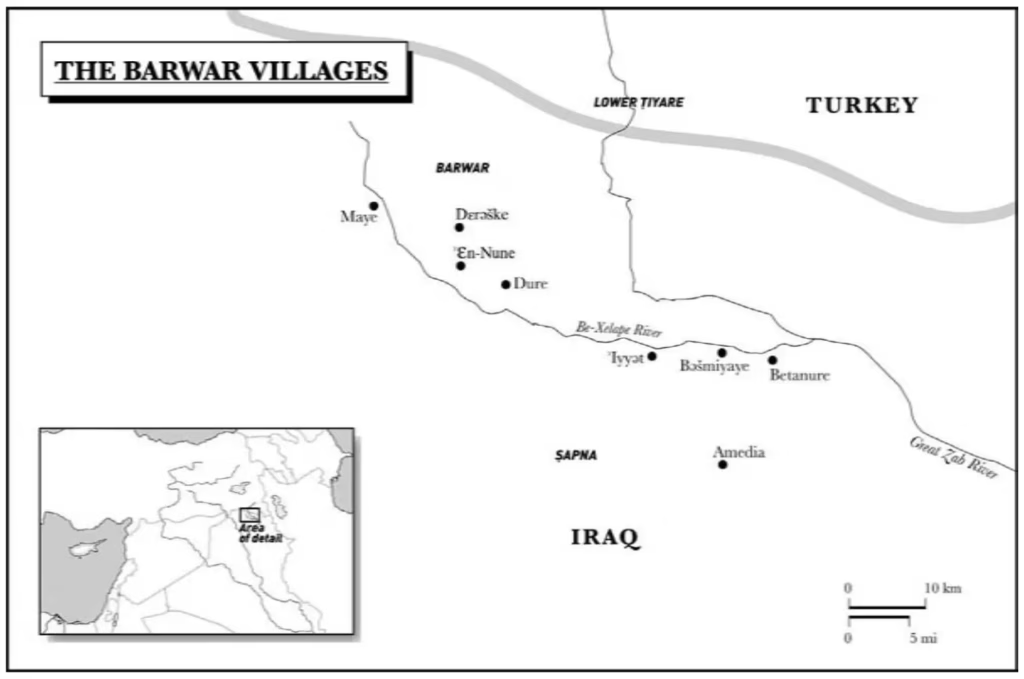
Map of Barwar
The Assyrians of Barwar
Prior to 1988, the Assyrian Christian community living in the villages of the region of Barwar in northern Iraq spoke a distinct dialect of Northeastern Neo-Aramaic. On the north, the region borders the Turkish province of Hakkari, separated by the Širani mountain chain. The destruction of the Kurdish and Assyrian villages by the Iraqi army (part of the ongoing Iraqi-Kurdish conflict) led to the dispersal of villagers into a diaspora outside of Iraq and threatens the survival of this dialect.
The largest village and administrative capital of Barwar is ʾƐn-Nune. It’s closest neighboring villages are Dure, Dərəške, Bəšmiyaye, ʾIyyət, and Maye. By about 1978, the Assyrian Christian population of these six villages comprised between 400-500 families. Other smaller villages included Bebeluk, ʾẸqri, Maləxθa, Sardašte, Halwa, Daštane, Xwara, Maxrabiya, Butara, Čallək, Jədida, Tašiš, Čaqala, Čamməkke, Hayyis, Margajiya, Mamadoka, Zəvinge, Maglana, Dargale, Musāka, Čammət Bəllo, Tuθe Šemaye, Bāz, Kani Balave, Čam Dastine, Hurke, Tərwanəš, Bazive, Bekozanke, and Betanure. Historically, the Assyrians of Barwar sustained themselves through agriculture and the herding of sheep and goats.
The Barwar Dialect
Geoffrey Khan was the first to systematically describe the grammatical features of the dialect (phonology, morphology, and syntax) in a three volume work on the dialect of Barwar (see bibliography below).
Bibliography
- Khan, Geoffrey. The Neo-Aramaic Dialects of Barwar, 3 vols. Leiden/Boston: Brill, 2008.
NENA Database Project
The North-Eastern Neo-Aramaic Database Project (https://nena.ames.cam.ac.uk/) hosted by Cambridge University gives access to recordings, transcribed texts and grammatical descriptions of the various NENA dialects. Most of these are now highly endangered and some of them have recently become extinct. Accessible here.
Geoffrey Khan's YouTube Videos (NENA Dialects + lagniappe)
"The Classification of the Modern Assyrian Neo-Aramaic Dialects" (Nov 2024)
"The Arabic Documents from Early Islamic Khurasan" (Sep. 2024)
"The Lailashi Codex: The Crown of Georgian Jewry," book discussion (May 2024)
Nabu Circle Lecture Series featuring Khan (Nov. 2023)
Jewish Language Project lecture by Khan (Aug. 2023)
"The Modern Assyrian Aramaic Documents and the urgent need to document them," lecture by G. Khan (May 2022)
"The Aramaic-Speaking Jews of Iraq and Iran," ILARA Cycle on Jewish Languages (Aug 2021)
Carmen Moran of ANB SAT interviews Khan (Mar. 2021)
Rebecca Simon of Shamiram Media interviews Khan (Mar. 2021)
Rebecca Simon of Shamiram Media interviews Khan (Feb. 2021)
Weam Namou of the Chaldean Cultural Center interviews Khan (Jan. 2021)
Hebrew Studies at Cambridge University (June 2020)
"The Aramaic-Speaking Jews of Iraq," presented at the Jews of Iraq Conference (Apr. 2020)
"Introduction to the North-Eastern Neo-Aramaic Dialects Lecture 1: Introduction and Phonology"
"Introduction to the North-Eastern Neo-Aramaic Dialects Lecture 2: Morphology"
"Introduction to the North-Eastern Neo-Aramaic Dialects Lecture 3: Syntax"
"Aramaic dialects of the Assyrian Christians and Assyrian Jews of Iraq and Iran" (Feb. 2016)
Khan in San Jose (Sep. 2014)
El Judeo-Árabe: "Jornadas sobre las lenguas y las literaturas judías de Europa y el Magreb" (May 2013)
"The Language of the Modern Assyrians and Its Historical Background" (June 2012)
"Karaite Studies: The State of the Field" (Mar 2012)
Intro Bibliography
- Khan, Geoffrey, and Masoud Mohammadirad. Language Contact in Sanandaj: A Study of the Impact of Iranian on Neo-Aramaic. Berlin: DeGruyter Mouton, 2024.
- Khan, Geoffrey, and Lidia Napiorkowska, eds. Neo-Aramaic and Its Linguistic Context. Gorgias Neo-Aramaic Studies 14. Piscataway, NJ: Gorgias Press, 2015.
- Khan, Geoffrey, ed. Neo-Aramaic Dialect Studies: Proceedings of a Workshop on Neo-Aramaic held in Cambridge 2005. Gorgias Neo-Aramaic Studies 1. Piscataway, NJ: Gorgias Press, 2008.
- Other bibliographic resources forthcoming.