Summer 2025, NACAL 48, and Comps
Introduction
This post offers a brief update on my recent academic travels over the past four months—primarily for conferences and workshops—as well as a snapshot of where things stand with my comprehensive exam preparation.
Summer 2025
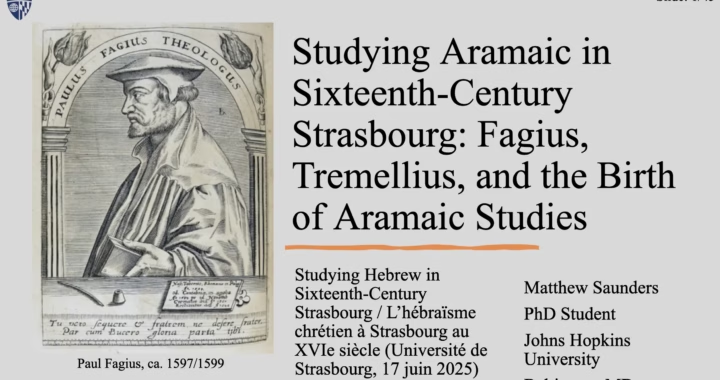
In a previous post, I detailed an “academic pilgrimage” through Germany, funded by some grants by the Leonard and Helen R. Stulman Jewish Studies Program at Johns Hopkins, the Singleton Center for the Study of Premodern Europe at Johns Hopkins, and the Max Kade Center for Modern German Thought at Johns Hopkins. To recap, from May 10-June 21, I traveled to Stuttgart, Tübingen, Berlin, Wittenberg, Erfurt, Heidelberg, Strasbourg, Göttingen, and Hamburg, including attending the following three conferences: Semitic Dialectology (Berlin); Studying Hebrew in Sixteenth-Century Strasbourg (Strasbourg); and Current Research and Challenges in Ugaritic Studies (Göttingen).
In the second half of the summer (June 21-Aug 5), I continued to travel throughout Europe for conferences and summer schools, including the International Society of Biblical Literature conference in Uppsala, Sweden (June 23-27); the Aram Society for Syro-Mesopotamian Studies’ Fifty-Seventh International Conference (June 30-July 1); and the Leiden Summer School in Languages and Linguistics (July 21-Aug 1). While in Sweden, it was nice to see the Nobel Prize Museum in Stockholm as well as to eat reindeer there. While in England, I finally traveled to Nottingham (of Robin Hood fame), Hadrian’s Wall, Stonehenge, and several castles and palaces (e.g. Windsor Castle). All of this was accompanied by additional personal travel, including a week in Scotland (Stirling, Edinburgh, the Highlands, St. Andrews, Glasgow) and Wales, and a week at an all-inclusive resort in the Canary Islands (studying for comps, of course).
My favorite part of the summer, as usual, was the Leiden summer school, where I participated in the following four courses: An introduction to Arabic paleography and epigraphy (Ahmad Al-Jallad); Comparative Semitics (Marijn van Putten, Benjamin Suchard, Ahmad Al-Jallad); Rabbinic Hebrew (Martin Baasten); and Classical Ethiopic (Martin Baasten).
NACAL 48
This past weekend, I attended the North Atlantic Conference on Afro-Asiatic Linguistics [NACAL] (Sept 26-28). According to the description on their website, “NACAL is an annual gathering featuring the presentation and discussion of original research on linguistic topics relevant to the languages of the Afroasiatic phylum (Berber, Chadic, Cushitic, Egyptian, Omotic, and Semitic).” The organizers this year were Ahmad Al-Jallad and Connor Rouillier, and it was hosted by the Ohio State University in Columbus, OH. Here’s the schedule:
Day 1 –
- Opening Address – C. Roullier and A. Al-Jallad
- Cody Beasley: Developments in the Arabic Modal System and a New Inscription from Khaybar, Saudi Arabia
- Phillip Stokes: Classical or Middle Arabic? On the Language of One of the Earliest Arabic Translation of the Gospels in Arabic (Vatican Arabic MS 13)
- Paul Fallon: Ejectives in Central Cushitic loanwords and native vocabulary
- Ruth Kramer and Matthew Hewett: In the Main Clause or in the Embedded Clause? Investigating a Cross-Clausal A-Dependency in Amharic
- Connor Roullier: Effects of Plural Type on Agreement in Six Arabic Varieties
- Alexander Foreman: Some Vowels to Think With: A Provisional Pre-Exilic Reconstruction of the Vocalization of the Song of Moses
- Roni Henkin-Roitfarb and Iris Alfi-Shabtay: Past Tense in Hebrew and English of Arabic-Speaking 11th-Graders in Israel
- Charles Häberl: Actionality Classes of the Verb in Modern Western Aramaic: The Dialect of Maaloula
- Jason Overfelt: Functional heads motivate hyperactivity in Tigrinya
Day 2 –
- Yishai Neuman: Lexical Propensity in Irregular Yet Expectable Phonological Variation in Semitic Roots and the Formation of Root Clusters
- Eran Cohen: The Common Semitic interrogative element *ʾayy
- Fahad Al-Sharif: Preliminary Notes on the Grammar of Urban Ḥijāzī Arabic
- Seth Wyatt: On the Egyptification of the Nuwaubian Language
- Ahmad Al-Jallad: Did Proto-Arabic have *[p] and *[tsˁ]? New evidence from old sources
- Letizia Cerqueglini: The Bedouin Arabic Dialect of the Maʿānīyīn Confederation: Features and Classification
- Ahmad Al-Jallad and Alessia Prioletta: The Original South Semitic Alphabet Mnemonic
- David Mihalyfy: Egyptian’s N-stems and Auxiliary Verbs as Further Evidence for Its Creolid Origins?: A Summary of Recent Research Findings, with Implications for Afroasiatic Prehistory
- James D. Moore: DLATO A Next Generation Digital Environment: Introducing DEAPS
- Na’ ama Pat-El: On syncretism in Semitic: a bug or a feature? [KEYNOTE]
Day 3 –
- Bethany Weppler: Discourse Analysis: Constructing a Bouzebal Identity through Interaction, Indexicality, and Turn-Taking
- Ambrose Arralde: The origins of the verbal stems shaphʿel and eshtaphʿal in Aramaic
- Michael I Leff: Allophony and Realization of the Proto-Semitic *s1
- Tyler Moser: “Disability Pattern” or Semantic Cluster? Nominal Patterns for Disability Terms in Semitic Reconsidered
- Alessia Prioletta: Nominal Morphology of the Non-Sabaic Ancient South Arabian languages
With respect to their ideas, which I hope they publish soon, I won’t provide summaries or analyses of the individual talks, but I do want to single out a few that I particularly enjoyed (in part due to proximity with my own interests in Aramaic and epigraphy): Häberl, Al-Jallad (both), Moore, and Pat-El. Additionally, I was extremely impressed with the quality of the talks from the three UT Austin PhD students–Arralde, Leff (formerly a JHU student!), and Moser–which were all convincing and well researched.
Comprehensive Exams
Later this week (Wednesday Oct 1), I begin a week-long series of comprehensive exams which tests my mastery of Syro-Palestinian history and archaeology; biblical criticism (esp. Pentateuch, Deuteronomistic history, and the history of the Hebrew language); Akkadian (cuneiform and linguistics); and Hebrew, Aramaic, and Northwest Semitic epigraphy (the entire corpus of the Hebrew Bible, incl. biblical Aram., as well as the major NWS inscriptions of the Iron Age). Needless to say, the last few weeks (months!) have been intense, and the final stretch promises to be even more so.
About The Author

Matthew Saunders
Matthew Saunders is a PhD student in the Department of Near Eastern Studies at Johns Hopkins University. He researches the languages and literatures of the ancient Near East, especially Aramaic Studies, Ugaritic Studies, and Comparative Semitics.
 An Academic Pilgrimage: Germany Summer 2025
  Semester in Review: Spring 2025 at JHU
  235th Annual Meeting of the AOS (2025)
  JHU-PTS Doctoral Symposium
  Fall 2024 Semester in Review
  ASOR and SBL 2024