Research Update (2025-2026)
TL;DR
This post provides a research update on how I spent the previous academic year. Here are the highlights:
- Passed comprehensive examinations and advanced to PhD candidacy (ABD)
- Taught four Hebrew courses at Johns Hopkins
- Presented research at Göttingen’s Alttestamentliches Doktorandenkolloquium as well as national conferences
- Became a contributor to Syriaca.org
- Published two new Safaitic inscriptions in OCIANA (here and here)
- Studied at Princeton, Leiden, and the Catholic University of America
- Attended seven national and international conferences, including ASOR, SBL, IACS, and Symposium Syriacum
- Conducted research and personal travel throughout Europe, Asia, and Central America
Introduction
The last update post I wrote was nearly one year ago, summarizing my summer 2025 travels throughout Europe and highlights from NACAL 48 in Columbus, Ohio. Since then, the past year has been one of significant transition and refinement in my research trajectory. Rather than attempting an exhaustive account, however, this post highlights a few of the more important developments over the past year.
Fall 2025
Coursework: Since this was my fourth year at Hopkins, I was not required to take any other coursework beyond preparation for my comprehensive exams and writing my dissertation prospectus. Nevertheless, I did take three courses which were too interesting to pass up: Archaic Aramaic; Archaic Hebrew Poetry; and Advanced Akkadian [Neo-Babylonian].
Teaching: In the fall semester, I taught two classes: (1) “Elementary Biblical Hebrew” for first year students, and (2) “Readings in Hebrew Prose” for intermediate students. In the elementary class, the students read through the entire grammar of Jo Ann Hackett, memorized some important verses in Hebrew, and even learned to read basic vocabulary in several different Hebrew scripts (including Paleo-Hebrew, Samaritan, Rashi, and Modern). The theme of the selected readings in the intermediate class was texts about the Arameans as well as texts which betrayed Aramaic linguistic influence (Aramaic-based code-switching).
Conferences: In November, I attended ASOR and SBL in Boston. At the latter, I gave a talk titled “Echoes of Scribal Culture: Formulaic Expressions in the Amarna Letters and the Hebrew Bible” (Nov. 22, 2025). I also gave another talk a few days earlier, titled “Scribal Lists and the Limits of Knowledge: The Rhetoric of Wisdom in the Book of Job in Light of Its Ancient Near Eastern Context” (Nov. 18, 2025).
Miscellanea: In September, I returned once again to Berlin to support my partner as she ran the Berlin marathon. On Nov. 2, a colleague and I drove to Washington D.C. to hear Prof. William Schniedewind give a talk on “Reconstructing the Tel Dan Inscription and Early Israelite History” at MOTB. For Thanksgiving, I took a short trip to Guatemala. (FYI, if you’re ever there, check out Hobbitenango!)
Holiday Travels: After a week in Tennessee to visit family, I spent the holidays in Asia, where I visited four new countries for the first time: the Philippines, South Korea, Taiwan, and Singapore. It was nice to catch up with an old friend in Taiwan, James Shu, who teaches Hebrew Bible at a seminary there.
Spring 2026
Princeton: From Jan. 12-16, I started off the spring semester strong with a one-week intensive course on Pre-Islamic Arabia and Arabic hosted at Princeton University, organized by Jack Tannous, and taught by Ahmad Al-Jallad. It was a pleasure to meet students from a variety of institutions, especially colleagues from Princeton and Yale.
Comprehensive Exams: I received notice on Jan. 28 that I had officially passed all my comprehensive exams, which was recorded with the Graduate Board, thereby advancing me to PhD candidacy (ABD, i.e. “All But Dissertation”).
Really Dead Languages: The following few days (Jan. 29-31), I celebrated my PhD Candidacy with the third annual workshop offered by the Department of Ancient and Medieval Languages and Cultures at The Catholic University of America, called “Really Dead Languages” (RDL). The workshop provides a series of one-hour crash course seminars in various rarer ancient languages, and this year’s sessions included Canaano-Akkadian (Andrew Gross), Old Turkic/Uyghur (Adam Bremer-McCollum), Qumran Aramaic (Andrew Litke), and Classical Armenian (Julia Hintlian), among others.
Coursework: With comps behind me, I needed a long break and did what every ABD student would do: I signed up to take nine classes. The coursework this semester was non-stop but exhilarating. At Hopkins, I audited (1) Ancient Israelite Religion, (2) Qohelet, (3) Advanced Akkadian, (4) Readings in the Talmud, (5) History of the Jews in Pre-Modern Times, (6) Semitic Sisters: The Intersection of Hebrew and Arabic Language Learning, and (7) Independent Study: Dissertation Research. At Catholic University, I took (8) Aramaic Dialects and (9) Syriac. Fortunately, the CUA classes were on Mondays and Wednesdays, while the JHU classes were on Tuesdays, Thursdays, and/or Fridays, allowing me to be in Baltimore and Washington, D.C. on alternating days.
Teaching: On Tuesdays and Thursdays, I also taught two classes at Hopkins (the continuation of the fall semester classes): “Elementary Biblical Hebrew II” (for second-semester students) and “Readings in Hebrew Prose and Poetry” (for intermediate students). In the elementary class, we completed Lambdin’s (1971) introductory grammar and read through the entirety of Ruth and Jonah. In the intermediate class, we read a selection of different texts in increasing difficulty: Gen 22; Jon 1-4; Ps 1, 2, 23, 29, 82, 121; Amos 1-2; Exod 15; and Job 1-3. The students were also introduced to various issues in reading Hebrew poetry as well as historical Hebrew grammar.
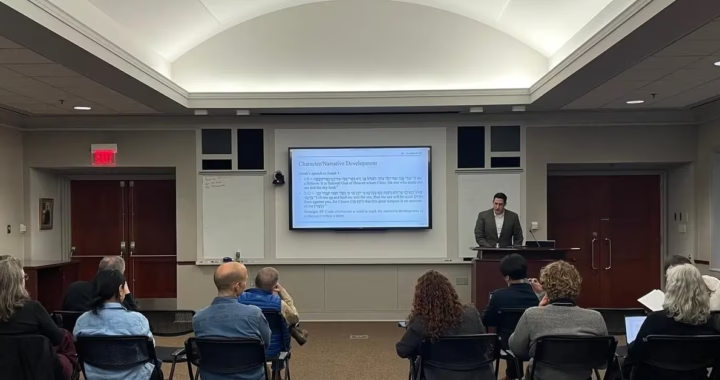
Conferences and Lectures: In addition to the Princeton intensive course and RDL workshop, I also attended several other conferences and lectures during the semester. On Feb. 28, I drove up (again) to Princeton for our annual JHU-PTS graduate student colloquium in Hebrew Bible/Old Testament. On Apr. 9, Derek Kennet (UChicago) gave the annual Albright lecture at JHU. On May 19-20, I attended the annual conference of the International Association for Comparative Semitics (IACS) at Penn State University in Pennsylvania (organized there by Profs. Gonzalo Rubio and Tawny Holm).
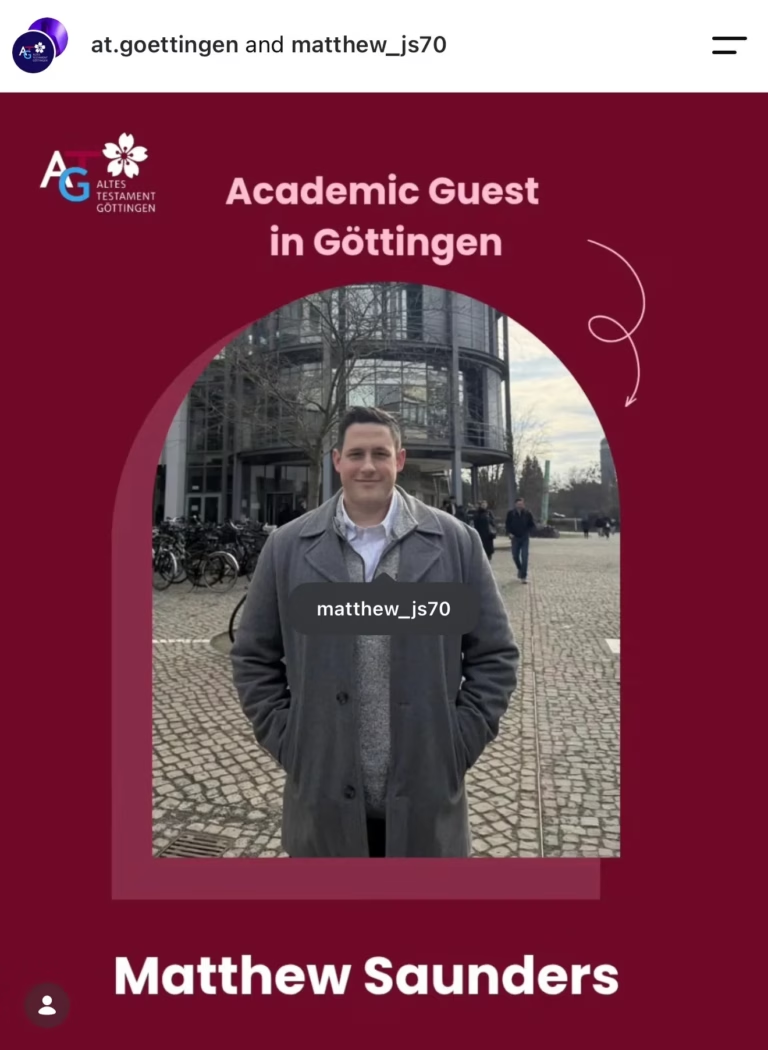
Göttingen (plus Hamburg and Marburg): The absolute highlight of the spring was my return trip to Germany from Feb. 3-14. The primary reason for my trip was an invitation by Prof. Dr. Reinhard Müller and his graduate student, Elisabeth Behr, to give a talk on my dissertation research at the Alttestamentliches Doktorandenkolloquium at the prestigious and historic Georg-August-Universität of Göttingen. (The reader will likely know that Göttingen was the home of many of the great and pioneering giants of the field, including Julius Wellhausen, Heinrich Ewald, Johann Gottfried Eichhorn, Hugo Gressmann, Paul Anton de Lagarde, and many others). My talk was titled “The Social History of Old Aramaic,” and in addition to the Göttingen faculty, I was honored to engage with Manfred Krebernik and Christian Stadel who were in attendance. The Old Testament department at the University of Göttingen even featured my visit as an “Academic Guest in Göttingen” through its departmental communications and social media (see image below). While in Germany, I should add, I also met up with colleagues in Hamburg as well as attended the Abschiedsvorlesung of Prof. Dr. Stefan Weninger in Marburg (farewell lecture on the occasion of his retirement).
Summer 2026
Online Classes and Workshops: This summer, I participated in five online classes and workshops. The first was an introduction to Classical Armenian in CUA’s summer program, taught by Dr. Monica Blanchard. I then participated in a Syriaca.org workshop on Digital Encoding for the Study of Syriac Literature with Profs. David Michelson (Vanderbilt) and Dan Schwartz (Texas A&M). After the workshop, I was even selected to serve as a contributor to the digital publications of Syriaca.org, including the New Handbook of Syriac Literature (NHSL). Finally, I took three week-long online classes with Profs. Ahmad Al-Jallad and Alessia Prioletta via The Epigraphic Institute: (1) Safaitic Epigraphy; (2) Ancient South Arabian; and (3) Introduction to Paleo-Arabic. As the capstone project of the Safaitic Epigraphy course, Prof. Al-Jallad assigned newly discovered Safaitic inscriptions and allowed us to publish the primary edition on OCIANA. My two new online publications can be found here and here.
Travel to Europe: In July and August, I traveled to four countries in Europe for various reasons: The Netherlands, Belgium, Italy, and Romania. While in the Netherlands, I completed the annual Leiden Summer School in Languages and Linguistics, where I took four classes in historical linguistics (with Stefan Norbruis), Northwest Semitics: Ugaritic and Phoenician (Agustinus Gianto), Syriac (Martin Baasten), and Readings in Ethiopic Literature (Martin Baasten). I then spent two weeks in Italy (primarily Florence and Rome), where, among many other highlights, I was able to purchase a first edition copy of Buxtorf’s Lexicon Hebraicum et Chaldaicum (1639/1640). Finally, I attended the Symposium Syriacum in Bucharest (my first time in Romania).
Conclusion: Looking Forward (Fall 2026)
In this upcoming semester, which commences in two short weeks, I will be teaching a graduate seminar on Comparative Semitic Grammar. In this course—which gives equal weight to East and West Semitic—we will be surveying thirteen Akkadian dialects alongside thirteen West Semitic languages (once each per week). Additionally, students will read the classics alongside contemporary issues in comparative Semitic theory and method. I also have a few trips lined up for conferences and research, the details of which I will share in due course. I look forward to sharing further updates as my dissertation and other research projects develop.
About The Author

Matthew Saunders
Matthew Saunders is a PhD student in the Department of Near Eastern Studies at Johns Hopkins University. He researches the languages and literatures of the ancient Near East, especially Aramaic studies, Ugaritic studies, historical Hebrew grammar, and comparative Semitics.
 Verbal Substantives in Proto-Semitic
  Summer 2025, NACAL 48, and Comps
  An Academic Pilgrimage: Germany Summer 2025
  Semester in Review: Spring 2025 at JHU
  235th Annual Meeting of the AOS (2025)
  JHU-PTS Doctoral Symposium